May 1, 2026 • Stuart, FL
How to Appear in ChatGPT Search Results and Get AI Recommendations
Here's something that keeps me up at night, and I think it should keep you up too if you're running a business: what happens when someone asks ChatGPT to recommend a local service instead of Googling it?
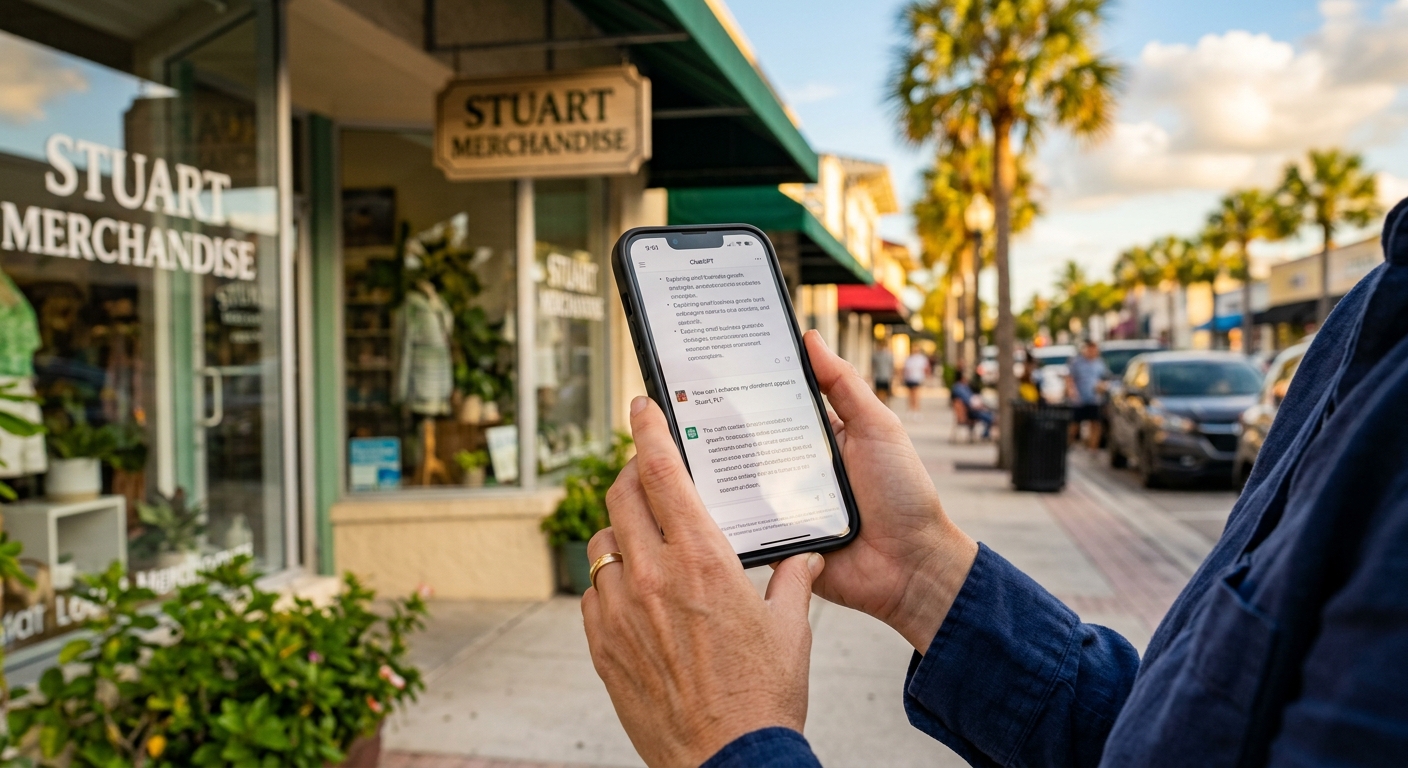
Five years ago, that question would've sounded ridiculous. Today? It's happening right now in Stuart and everywhere else. People are asking AI chatbots for recommendations before they hit Google. And if your business isn't set up to show up in those results, you're missing out on customers who are actively looking for what you sell.
I'm the team lead at MarketKing AI, and we've spent the last couple of years figuring out exactly how this works. We call it GEO, which stands for Generative Engine Optimization. Think of it as SEO's younger sibling that's growing up fast. Instead of optimizing for Google's algorithm, we're optimizing for AI chatbots like ChatGPT, Claude, and Perplexia. And the rules are different.
Let me walk you through how to get your business in front of these AI systems.
What Is GEO and Why It Matters for Your Business
GEO is the practice of optimizing your online presence so that AI chatbots recommend your business when someone asks for help. It's not the same as traditional SEO. Google cares about keywords, backlinks, and page speed. ChatGPT cares about something different: authority, relevance, and how frequently your business appears across the web in a trustworthy way.
When someone in Stuart asks ChatGPT "Where should I get my roof inspected?" the AI pulls from its training data. That training data includes news articles, business directories, review sites, and other authoritative sources. If your roofing company has been mentioned in local news, has legitimate reviews, and shows up consistently across the web, ChatGPT is more likely to recommend you.
Here's what's wild: this isn't a paid advertising space (yet). This is earned visibility based on your actual reputation and online presence.
How ChatGPT and Other AI Chatbots Find Businesses

Before you can optimize for ChatGPT search results, you need to understand what data these systems are actually trained on. ChatGPT's knowledge was built up until April 2024. That means the more recent content you create and the more consistently you appear online, the more likely you'll be in the next version's training data.
AI chatbots pull from:
- Business review sites (Google Business Profile, Yelp, Trustpilot)
- Local news mentions and articles
- Your website content and blog posts
- Industry directories and associations
- Social media presence
- Citations across the web
As you can see in the photo above, the sources that carry the most weight are the ones that humans trust. That's the key insight. You don't need to game an algorithm. You need to build real authority.
We see this every day at MarketKing AI. When a local business gets mentioned in the Stuart News or the Palm Beach Post, when they accumulate real customer reviews, when they maintain consistent information across Google Business, Facebook, and their website, that's when ChatGPT notices them.
Step 1: Optimize Your Google Business Profile for AI Discovery
Your Google Business Profile is ground zero. This is one of the most authoritative sources that ChatGPT pulls from. If your profile is incomplete, outdated, or inconsistent, you're already behind.
Here's what you need to do right now:
Make sure your business name, address, and phone number (NAP) are exactly the same everywhere. Not "Stuart FL" in one place and "Stuart, Florida" in another. Exact match. This consistency tells AI systems you're a real, legitimate business.
Add photos. High-quality, recent photos of your business, your team, and your work. ChatGPT can't see images, but it uses signals from trustworthy sources. A Google Business Profile with lots of recent photos is a signal that your business is active and legitimate.
Write a detailed business description. Don't just copy what you wrote five years ago. Use clear language that explains what you do, who you serve, and why customers should choose you. Include local references. If you're in Stuart, mention that. If you serve Palm Beach County, say it.
Respond to reviews. Every single review. Positive or negative. When you engage with customer feedback, it shows you're an active business that cares about customer experience. AI systems notice this.
Step 2: Build Your Content Strategy for How to Appear in ChatGPT Search Results
This is where a lot of businesses get stuck. They think content strategy is about stuffing keywords into blog posts. That's not how you appear in ChatGPT search results.
ChatGPT remembers information that appears in authoritative places multiple times. If you publish a blog post on your website once, ChatGPT might see it. If that same information gets picked up by local news, gets mentioned on industry sites, and appears in a few business directories, ChatGPT will definitely remember it.
So your content strategy should focus on creating information worth sharing. Write blog posts that answer real questions people ask in Stuart. Then share those posts on social media. Pitch them to local news outlets. Get them mentioned in industry forums.
At MarketKing AI, we help businesses create what we call "hub content." This is detailed, authoritative information that covers a topic completely. When you write hub content and it gets distributed across multiple trustworthy platforms, that's when AI chatbots take notice.
For example, if you run a pest control service here, you could write "The Complete Guide to Dealing with Termites in Stuart." This becomes your hub. Then you distribute it. Local news might pick it up. Homeowner blogs might link to it. Before long, when someone asks ChatGPT about termites in Stuart, your business is more likely to get recommended.
Step 3: Get Mentioned in Local News and Authoritative Sites
This is the part that actually moves the needle.
Local news mentions carry enormous weight with ChatGPT. When the Stuart News mentions your business by name, when you get quoted in an article about your industry, when you're featured as a local expert, that's data that ChatGPT can't ignore.
How do you get local news mentions? Start by building relationships with local journalists. Read the Stuart News. Follow reporters on social media. When they cover a story related to your industry, reach out respectfully with an expert perspective.
You can also reach out proactively. Local news outlets are always looking for stories. If you've just completed an impressive project, if you're hosting a community event, or if you've implemented something new in your industry, that's a story.
Get listed in industry directories and associations. If you're a real estate agent, join the Florida Association of Realtors. If you're a contractor, get listed with the Better Business Bureau and local trade associations. These are authoritative sources that ChatGPT trusts.
As you can see in the photo above, the most visible businesses are the ones that show up everywhere. Not just on Google. Not just on their website. Everywhere.
Step 4: Generate Consistent Reviews and Social Proof
Customer reviews aren't just for Google. They're part of your overall reputation that feeds into how ChatGPT perceives your business.
Make it easy for customers to leave reviews. Send a follow-up email after a purchase or service. Include direct links to review sites. Ask them to share their experience.
The more reviews you have, the more authoritative you become. ChatGPT's training data includes review sites. A business with 50 five-star reviews on multiple platforms looks way more legitimate than a business with no reviews.
Also, monitor where you're being reviewed. Make sure your information is consistent across Google, Yelp, Facebook, industry-specific sites, and anywhere else customers might review you.
The Future of Search Is GEO
Here's the thing nobody's talking about yet: traditional SEO isn't going away, but GEO is becoming equally important. We're at a moment in time where businesses that optimize for both Google and AI chatbots are going to dominate their local markets.
In Stuart, we're already seeing this play out. Businesses that have strong local authority, consistent citations, real customer reviews, and content that gets picked up by trustworthy sources are the ones getting recommended by ChatGPT. And that's brand new customer traffic that most businesses don't even know exists yet.
If you want to appear in ChatGPT search results, focus on building real authority. Be active in your community. Create valuable content. Get mentioned in local news. Accumulate genuine customer reviews. Make sure your information is consistent everywhere.
That's it. You're not gaming an algorithm. You're building a reputation that AI systems can't help but recognize.
At MarketKing AI, we help businesses in Stuart and across Florida implement GEO strategies alongside their traditional SEO. If you're ready to show up where your customers are actually looking, reach out. We'd love to help you build the kind of online presence that both Google and ChatGPT recommend.
Your competitors are probably still thinking about Google page one. You could be thinking about appearing in ChatGPT's recommendations. That's a competitive advantage worth having.
Ready to Rank #1 in Stuart, FL?
We build AI-powered SEO content that gets local businesses to page one on Google.
See Plans & Pricing →